Herm Hundere
Herman Bjarne Hundere
 Baby Herman 1919
I was born in the Lutheran Deaconess Hospital, Minneapolis, Minnesota, January 27, 1919.
My father was Hans Hundere, a Norwegian immigrant, born May 20, 1872
My mother was Bertha Cecilia Olson-Larson, a first generation American , born in Minneapolis, MN Jan. 16, 1886
Until the year I went in the army during WWII, my life was spent in Minneapolis. When I was born my folks lived on Colfax Avenue in North Mpls. They later moved across the Mississippi River to Johnson Street Northeast. I don't remember these places, but we were living on Johnson street when my earliest recollection occurred. It was the burning of the Champlin Bridge, probably around 1922 and I remember the fire engines racing down Franklin Avenue to fight the fire. That bridge was replaced with the Franklin Avenue concrete arch bridge, but the last time I looked, the piers from the Champlin bridge were still there.
Later we moved to 3242 Chicago Ave. in South Mpls. and I was scheduled to start Horace Mann grade school in January, but came down with the measles and didn't start Kindergarten until the following September. While I was in bed with the measles the great blizzard of 1924 occurred. The only thing I remember of that storm was that the streetcars that ran past our house stopped completely for a matter of days and when I had recovered enough my dad took me down to Lake Street so I could see street cars that were actually running.
I only remember the name of one teacher at Horace Mann, possibly because her name was Lindberg and she was my third grade teacher in 1927, the year Lucky Lindy flew the Atlantic. My mother took me over to Park Ave to see the Lindberg parade after he returned from Paris and was on his way to his home town of Little Falls. I remember attending a parade which had to be in the fall of 1924 when President Coolidge was running for reelection. Our school went en masse down to Lake street and sat on a hill between Elliot and Tenth Avenues to watch. Not being of voting age I was more impressed by the hole they were digging across the street from our vantage point. It was the basement which was under construction for the planned 13 story Sears building. The hill we sat on ultimately became the site of a branch bank and 70 years later my brother Erling, my two daughters and I inadvertently sat in a car at a stop light outside that bank while it was being held up by two gunmen who were holding hostages inside the bank.
Powderhorn Park which was two blocks from our home was the mecca for all community activities as early as the '20s after they drained the marsh and filled in the north end of the lake and the park board installed backstops and put in baseball diamonds. I learned to skate and ski there and rode the toboggan slides in the wintertime. In the summer there were band concerts and we would sit on the hillsides, around the bandstand, listen to Harry Anderson and his band and feed the mosquitos. At the South Side Picnic and the Fourth of July the whole city showed up at Powderhorn Park for the games, races and rides. After dark we OOhed and ahed the best fireworks anywhere.
As a member of the YMCA Knot hole gang I saw my first professional baseball game at the old Nicollet Ball Park, it was the home of the AAA, Minneapolis. Millers. Over the years, until The Twins arrived on the scene I saw local minor leaguers Ted Williams Ray Dandrige and Willie Mays, play against the likes of Roy Campenella, Pewee Reese, and Phil Rizzuto who were also on their way to the majors. I also saw Babe Ruth at first base in an exhibition game when he barnstormed when his playing days in the majors ended.
My maternal grandmother Constance Larson, Nee Svendson lived with us on Chicago Avenue for a time until she had a stroke. I was maybe four when she taught me the intriccasies of coffee drinkng, starting with my dunking a slice of bread in her cup of coffee at breakfast and moving on to a saucer of coffee of my own before I graduated to a full cup of coffee with real cream. That was before homogenized milk. Milk came in a glass quart bottle, the top three inches or so was cream which was poured off into a cream pitcher for coffee and was delivered by a milk man daily with a horse drawn wagon. Under the milk wagon was a big metal plate about the size and weight of a manhole cover which was attatched by a chain to the inside of the wagon and could be let down to the street as an anchor while the milkman delivered to his customers. However, we took from Franklin Creameries and our guy had a well trained horse that would follow along down the street as he delivered. (Until I started recalling this, I never realized that I never drank anything but skimmed milk while i was growing up). Incidentally, on sub zero days you could hear the steel rims on the wagon wheels squeel as they rolled along on the packed snow of the street and if you left the milk out on the stoop too long the milk it would freeze and raise the cream off the top of the bottle, then you would cut the cream portion off the milk with a knife and drop it into a pitcher to melt.
 Hans, Bertha and Herman with the Model T
Our model T was an open touring car , but it had side curtains for inclement weather . In the winter you had to crank it to start it. There were two levers on the steering column, one for gas and one for spark, If it didn't start up after two or three pulls on the crank, you jacked up the left rear wheel advanced the spark and spun the crank, if you gave it too much spark and the engine back fired while you were cranking the crank reversed and you could end up with a dislocated thumb or a broken arm.....maybe both. A lot of cussing went with starting the model T.
Grade School
In 1929 My folks bought a place at 3401 East Fortieth Street and that fall I started Simmons Grade School on thirty eighth street and Minnehaha Ave. MIss Rachel Reberg was my fifth grade teacher. One day a kid in our class named Lindholm packed a 22 gage shell casing full of caps during a study period and inadvertantly set it down on his desk hard enough for it to explode with a hell of a roar. No one was hurt, Miss Reberg seemed panic stricken but once she found out that the kid was okay she sent him out to the john get the black soot off his face and that was the end of it for her, until 18 years later when she heard that I was at the Vets hospital after WWII and she came out to visit me. I hadn't seen her in all that time, but while we reminisced, I reminded her of the incident, which she denied ever happened.
My first year at Simmons, Mildred Bostrom a girl from my class at Horace Mann whose folks had moved into the neighborhood during the summer, also transferred into Miss Reberg's class. She is my only classmate from Kindergarten through the 12th grade. After graduation I would see her from time to time on the streetcar on the way to work in downtown Minneapolis, we never spoke to each other and when she returned from California as Mrs Shea for the 50th class reunion of the Roosevelt class of '37. And we chatted . . . . finally, she told Billie that she had had a crush on me all the way through school, I have to admit the crush was reciprocal on my part but she was so smart, so good looking and so popular in school that I was intimidated by her. At 68 years old she still was smart, good looking and popular and I still was intimidated and if I saw her today, I'm sure I still would be. . . . intimidated!
In 5B, at Simmons grade school I was appointed school courier. Thursdays as courier I went to the court house in downtown Minneapolis. I was given two streetcar tokens to take a large envelope of records down to the Board of Education offices and return to school. By the second week as courier I had figured out how to make the round trip on one token by transferring around and returning to school on the 38th Street bus.
In the sixth grade I was one of six crossing guards at Simmons, in grade school, the crossing guards were rewarded with a ticket to a University of Minnesota Football game a year, always Purdue, at that time Purdue had no stadium and played all their games on the road and since they were not very good there were always seats which went to the crossing guards, so my first college football game was the Gophers versus the Boilermakers and since that time, I must confess, I have been been a closet Purdue fan except when Notre Dame and Purdue meet. My father influenced me to become a Notre Dame football fan as soon as I could read a sports page since his landsman, Knute Rockne coached at Notre Dame. My father, I must admit, was more a Rockne fan than a Notre Dame subway alumnus.
My dad was an ordained minister and had served a church of the Lutheran Brethren (a small synod with roots in Norway), in Superior Wisconsin before moving to Minneapolis, and my folks were members of the Ebenezer Lutheran Church, also a Lutheran Brethren Church, on 19th Avenue and Third Street, now the home of the Carlson School of Management and part of the University of Minnesota Campus. The congregation, in the meantime, moved out to 41st Street and Cedar Ave.
From time to time my dad served as interim pastor of Ebenezer, but he was mainly active in the Hauge Inner mission Society, a group of lay people, Norwegian immigrants, who gathered in various churches around the state for bible study and devotion in the ways of the old country when the "Free Church" was formed after breaking away from the Norwegian State Church. So my dad adhered to this tradition which probably had its beginnings with the Vikings. I mention this to give you background.
Thirteen is considered the "age of reason" in the Lutheran church and therefore it was also the age of confirmation for the youth of the congregation, which fundamentally involved memorizing Luther's Catechism. At Ebenezer you studied two years before you were confirmed, so at twelve I started, "reading for the minister" and the fight began when my dad said I was going to be confirmed in the Norwegian language. So I went toe to toe with both my father and Martin Luther in Norwegian, griping and moaning every Friday night when I sat down to memorize Saturday morning's lesson which was conducted by the then pastor of Ebenezer, Clarence Walstad..
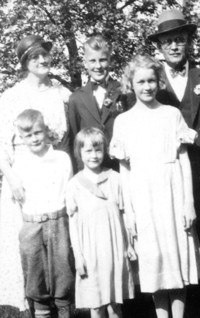 Hundere Family at Herman's Confirmation
When I graduated from grade school I left two of my siblings behind at Simmons to carry on for me, my sister Dagny, who was in the fourth grade and my brother Erling, a first grader. My youngest sister Jeri, (Hjordis) was 4 years old and had not yet started school.
While I was in Junior High I got a paper route for The Minneapolis Star. The route covered an eight block area south of fortieth street and East of Minnehaha Avenue. After school every afternoon I rushed th5rough my route to get to the vacant lot on fortieth Street and 38th Avenue where the neighborhood "gang" gathered to play ball in a sand lot game of whatever sport was in season at the time. It was on that lot that life long friendships were made and nurtured. We started out as neighborhood kids that continued as friends until we all left to go into the service. The relationships continued after we returned from the war in most cases even though we drifted apart geographically. I still have and treasure the picture we took together on a fall Sunday afternoon in 1941 just before the first three guys, were called up. In the picture are Arnie Ness, Bud Bordsen, Andy Eggan, Vern Emerson, Bud Thompson, the Carlson Brothers, Jim Paulson, Howie Allen and Otto Peterson. Missing from the picture are Red Westby, "Pork chops" Berg and Art Nelson, Windy Peterson, "Club foot " Anderson and his brother whom we dubbed as "Carideo" because he was not as good an athlete as he thought he was, but still went out for football at Roosevelt and as a member of the scub team ended up a tackling dummy for the varsity.
High School
On a cold Friday afternoon in January 1934 I graduated from Sanford without fanfare and started the tenth grade at Roosevelt High the following Monday morning. Now I was in classes with students from two other satellite schools plus some of my old classmates from Simmons grade school as well as Sanford.
Some of us from the Fortieth Street Lot beside Carideo went out for various sports after we got to high school, none of us ever made the starting line up in any of them. In fact, I thought there were some pretty good athletes that came to Roosevelt from Sanford Junior High. However, over a period of some five years that I remember, only three from Sanford made the varsity in any sport at Roosevelt; Lloyd Parsons, fullback, was All City and all State.went on to star at the University of Minn and later played with the Detroit Lions. Hank Bergeson, was an all city tackle, and joined the fire department instead of going on to college. Jimmy Strang was all city in both baseball and football, and played baseball professionally in the Northern League until he joined the navy. He was lost at sea when the submarine 09 disappeared. You had to be outstanding to beat out the competition from Nokomis and Folwell Junior highs to even get a chance to make the team. I don't know why Sanford athletes were discriminated against, I always said it was because we were from the wrong side of the tracks!
By the time we were seniors in high school most of the "gang" were playing baseball in the park league. Otto, Vern, Bud and I played for Grossman Chevrolet at one time, and we played against varsity players from school and more than held our own against them. After high school Vern Emerson made the starting line-up in both football and baseball at Macalaster College and after the war was offered a contract with the Yankees, Bud Thompson played basketball and baseball at St Olaf and Judd Carlson played baseball and basketball at Carleton college. At 150 lbs on a 6 foot frame I had the good sense to avoid high school athletics.
At that time four of the Minneapolis High Schools, including Roosevelt offered Norse classes as an elective. By prearrangement, five of us from the neighborhood "gang" took "Norse one" one semester. The five of us came from bilingual homes and Red, Pork Chops, Otto and I took Norse because we figured it to be an easy credit. Besides after the confirmation fiasco with my dad, he insisted that I take two years of Norse. Andy took it because his uncle, Ben Eggan, taught the class and he figured he was a shoo-in for an A. Also in the class was Dorayne Wibeto. Her dad and mine had known each other in the old country and our folks were friends before we were born. Her family belonged to Ebenezer and she was confirmed a year after I, so we both "read for the minister" during my second year. I cannot ever remember not knowing her
Strangely, I stayed out of trouble in class and I had a good relationship with B.R.Eggan which lasted nearly a half a century. In 1972 Daughter Sue, Billie, Billie's mother, "Mimi" Hunt and I flew to Norway on a Sons of Norway sponsored flight. We rented a car in Oslo on Sunday after a couple days of getting over jet lag and headed for Mimi's birthplace, north of Trondheim. On the way we stopped in Lillehammer to look up Mr Eggan who was conducting a Norse camp for American kids there during the summer. We hadn't seen each other in thirty years, and after the introductions all around, he walked over to Mimi and said, "What I remember about this guy, is that after two years my class he told my sister-in law that old man Eggan finally coughed up an A". Well it's nice to be remembered for something.
Since the "thirties" were the height of the great depression there were no after school jobs to be had and the after school sessions continued for us at the fortieth street lot. As the older guys graduated from high school and found work, joined the CCCs, or went to college, younger kids filled their places and the lot continued as the mecca for neighborhood teens until the war.
I don't recall any of the gang as good students and I doubt if any of us graduated in the top 60% of our graduating class. I flunked "geometry one" and had to take it over and pick an elective to make up two credits to graduate. I took "water colors one" in the 12th grade and ended up in the same class with Dagny. I'm sure she dreaded my presence in that class, but I kept my nose clean because I didn't want her finking on me.
I took up flute and clarinet in the the tenth grade in order to keep out of singing classes and by 11th grade I was good enough to to get in the band. I was fifth chair in the flute section, in my senior year, the kid in the fourth chair was Ray Lindquist , a sophomore. After my graduation I never saw him again until the winter of 1945, my outfit had come off the lines on the Meuse River after the " Battle of the Bulge" . We were billeted in Pre Les Meziers, France and I was sitting one night in a bistro called the Riviera unwinding over a couple of cognacs when a Second Lieutenant came over to me from a crowd of GI s in brand new ODs and asked if I was Herm Hundere. It was old Ray himself, all growed up, just out of OCS and wearing shiny new bars and all. His outfit had come overseas a week before and they were moving up into the Ardennes on the Luxembourg border the next day to replace my outfit. So we chatted over a couple more cognacs, I must admit it was good to see him and talk to someone who had been stateside a week before. I had been overseas for 16 months by then and had been through some bad times. We parted and It was another 10 years or more before I saw Ray again, this time at the Post Club at Ft Snelling Minn. He was the guest of friends of ours at an Ellerbe company soiree and so we renewed acquaintances over martini's this time, he told me then that he lasted two weeks on the lines at Metz, France before he was wounded and shipped home. In 1967 I met Ray again, this time in the Monogram Room of the Notre Dame Athletic and Convocation building. We were both guests of O'Brien Paint Company at a pre-victory brunch before a UND / Southern California Game. He was, at that time, President of the Minnesota Linseed Oil Company. I ran into Ray at a 50 Plus Reunion of Roosevelt High in 1999, over 30 years had passed since I last saw Ray by then. We again had our usual drink together, toasting an off and on acquaintance that dates back to 1936 in High School.
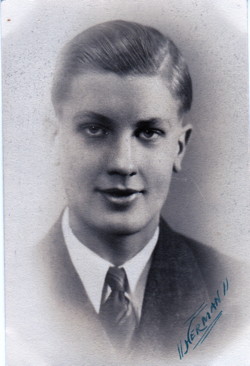 High School Graduation
The summer of '36 I won a trip to Chicago from the Mpls Star. I saw my first major league game, Cubs versus the Brooklyn Dodgers, did all the usual sight seeing bits, swam in lake Michigan off the Oak street beach, but skipped the trip to Lincoln park zoo and took the South Shore RR to South Bend and went out to Notre Dame, to walk the campus and roll on the grass in the stadium.
Our 187 member January class of 1937, which included Otto Petersen and me held graduation exercises in the Roosevelt School Auditorium on the evening of January 27th 1937, my eighteenth birthday. It was a bitter cold night, 27 below zero. As far as I know there were no celebrations.
After High School
I beat the streets looking for work after graduation, without much luck on my own, but my dad got me a seasonal job with a company owned by a of a friend of his. Name of "Tweet Nest Company" they made products for chicken farmers and hatcheries, brooders and the like. I worked ten hours a day, plus four on Saturday, all straight time, a 54 hour week on a spot welder at 25 cents an hour. By June I was out of work again, but I picked up a few bucks playing semi pro baseball during the summer.
That summer (1937) I was also named a delegate to the youth convention of of the Lutheran Brethren Church and went up to Fergus Falls to their annual meeting. There I met a young lady from Grand Forks and we hit it off terrifically. Turned out her mother and my mother had known each other as children in Whapeton N.D. were they grew up. After the convention we corresponded for a couple of years, and when her family came to Mpls for the State Fair and to visit relatives we dated. I went up to Grand Forks and visited once and her brother Gil who had connections got me a tryout with the Crookston baseball team in the Northern league. They only offered 60 bucks a month and pay your own expenses at home. I figured I was worth more than that so I passed on the opportunity to become a professional baseball player. . . . . Professional? . . .ha ha. Oh I forgot, the girl's name was LaVerne Thompson, HERE IT COMES!. . . . . she's the girl friend who married George Allen.
In the fall I got a job with the Leitz Carpet Company, a wholesale floor covering firm in North Mpls. During the time I was unemployed, President. Roosevelt changed the standard work week to 40 hours and congress set twenty cents an hour as the minimum wage with time and a half for over forty hours in a week. So except during the Christmas rush, I worked an eight hour day and had Saturdays off. I was paid on the first and fifteenth of the month, $32.50, less deductions for Blue Cross and Income tax. My mother took half of my take home pay for room, board and laundry. The rest I spent on frivolous stuff like entertainment , dating and clothing.
I worked in the warehouse as an order filler, making up shipments for freight and truck shipment to furniture dealers in the upper Midwest. After two years as flunky, I was sent by management along with a guy named Marvin Arf who worked in purchasing to Kearney, New Jersey (Across the Hudson River from Manhattan) for two weeks of schooling at the Congoleum Nairn Company whose headquarters were in Kearny. We pooled our travel money and took Marv's car east. Marv and I got around New York a good bit while we were in the East. We took the subway to Coney Island and did the parachute tower thing, we roamed the Jersey docks where they were arming freighters with deck mounted ack ack and 50 cal machine guns. (This was in 1939 two years before we got into the war). I saw my first television show, a prize fight from Jamaica, Long Island . On Sunday morning I attended church service at Trinity Lutheran in Brooklyn, where Pastor Walstad, who had confirmed me was now pastor. Sunday afternoon I went to the Polo Grounds and saw Carl Hubbel pitch for the Giants against the Cards.
When we returned to Minneapolis, I was transferred up to the City Desk and my job was writing up all orders long hand and of course now that I wore a suit and tie to work and was working regularly I gradually drifted away from the Fortieth Street gang and saw them mostly on weekends and established relationships with the younger crowd at Leitz.
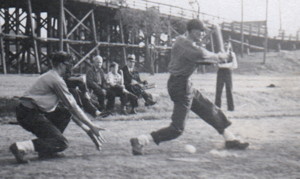 Playing Softball for Leitz
The following summer Jack Long, who was in Inventory Control at Leitz, and I took off on a three week vacation with a tent, some grub and sleeping bags in his old Ford and headed west through South Dakota, touring the Bad Lands and visiting the "Wall Drug Store" where we bought cowboy hats and continued on to Rapid City. We camped at Mt. Rushmore one night , the next morning onward to Lead , Deadwood and Devils Tower, Wyoming.
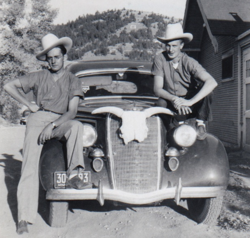 Out West with Jack Long
Jack and I have never lost track of each other, he returned from the Marines after WWII and married a girl he had met in California and settled near Riverside CA. We visited every time I went to California and got together when he came back to Minneapolis. He has gone through two divorces and now lives with his third wife, whom he met in Australia during the war, in Tindalls Bay-Whangaparaoa, Aukland, New Zealand and we still exchange Christmas letters.
Minnehaha Lutheran Church, naturally included several members of the Fortieth street gang. and in the early 40's had a softball team in the church league. So I started attending church there to be eligible to play ball in the summer. In the winter I ski jumped and tobogganed at the Deer Pen in Minnehaha park and skated at Horse Shoe Bend on Minnehaha creek behind the Longfellow Gardens Zoo. A bit eerie in sub-zero weather to hear a lion who was native to the darkest jungles of Africa.roar no more than 50 feet from where you were ice skating.
Bud Bordsen, Art Nelson, Jim Paulson and Bud Thompson not only played ball on the church team but were also choir members. After ball season was over I was conned into joining the choir. The director was obviously not familiar with my track record in singing, or they must have been desperate for basses to accept me. It was in choir that I met Lil Faro, she and her sister Myrt sang in the alto section. I did not know the Faros from high school because they were from "the other side of the tracks", but in the fall of 1941 Lil and I started dating..
In September Andy, Otto and Jim were called up and were inducted at Ft Snelling and shipped off to California and the infantry. By December 7, 1941, Windy Peterson and Dick Carlson were also in the service. On the Sunday, "that shall live in infamy", Arnie Ness and I had grabbed a streetcar and gone bowling and finally ended up at a movie on Bloomington and Lake so we had heard nothing of the raid.. When I got home my dad told me we were at war and said the Japs had bombed Pearl Harbor, I hadn't the remotest idea where the heck Pearl Harbor was.
The recruiting offices did a land office business the next few days with guys getting caught up in patriotic fervor. I was One A in the draft and everyone, especially vets from WWI, told me to wait until the draft board came to get me! So I kept on at Leitz, Lil and I kept dating and our friendship became more serious. Christmas that year was a very somber one in the states with casualty lists from the South Pacific coming in daily. Lil had three brothers who also were beginning to feel the hot breath of their draft boards on their backs. So we all were waiting for a letter that commenced; "GREETINGS, From your friends and neighbors".
Street Car Stories
Before I leave Minneapolis and go on any further I have to relate a couple more street car stories. Street cars were an integral part of my life growing up in Minneapolis, two tokens for fifteen cents and you could ride all day for seven and a half cents if you knew how to transfer around.
And there were tales of Halloween nights before my time when the street car tracks on Lowry Hill at the end of downtown Hennepin Avenue were oiled and the trolleys coming from down town would go careening down the hill past the Basilica, sparks flying from the motorman applying the brakes , and street cars heading up the hill on the return trip would get part way up and stall, wheels spinning due to lack of traction. The police put a stop to that by guarding the hill on Halloween.
Street cars were also vulnerable in snowstorms because motor traffic would pack the rails with snow and then the rails iced over and the street cars frquently jumped the tracks in snowstorms.
There were two lines that traveled between Minneapolis and St Paul, the Selby Lake and the Como Harriet , if you went from one city to the other it cost you two token and there was a motorman and a conductor on these cars. You paid a token when you got on and once you crossed the city limits to the other city you paid again when you got off. If you were traveling in just one city you paid when you got off. At the rear of the two man street car was a pole on which the conductor hung the token box when he came on for his shift and below that was a permanent tin container the size of a bread box that the conductor used for storage, gloves, his cap, transfer pads, whatever. At the front and rear of all street cars were "peanut rows" , seats each holding four passengers, facing each other. We always sat in the rear peanut rows because you could smoke back there without being hassled.
I know, it's a long way around to get to a story but several of us were sitting back there on a street car that had obviously been used at some prior time on the Selby Lake run because one of the fellows inadvertently happened to kick the container and the door flew open and a whole sheaf of unused Selby Lake transfers fell out. . . . . . .A bonanza! . . . . . The guy, who shall remain nameless went to the dime store immediately and bought a punch and I don't recall him ever paying to ride the "yellow dragons" again.
Another time we were sitting in the peanut row across from an off duty cop on his way home and reading the evening paper. As we got off at the rear gates of the trolley, the policemans's newspaper caught fire. We disembarked and stood on the sidewalk as the streetcar started off and noticed the policeman doing a weird sort of dance that involved a lot of stomping around at the rear of the trolley. I always assumed that was how the "stomp" started.
There was another Twin City line. From down town St Paul you could ride the West Seventh Street line to the end of the line at the Ft Snelling Post where you got off. If you wanted to continue you boarded the Ft Snelling car that went down Minnehaha Ave. to downtown Minneapolis At Ft Snelling you could also ride the "Dummy Line" free from the West Seventh Street Bridge west to what is now part of the Twin cities Airport. It was a one track one trolley line and the motorman just changed the overhead trolley from one end of the car to the other and went to the controls at the other end of the car for the return trip.
They began tearing up the tracks, "for the war effort" and sold off most of the rolling stock to cities in South America.
World War II
In January '42 I got a call from Ben Eggan, he had recommended me for a job as a translator for for the government, and said if I was interested to report for the civil service test. I took the test along with ten or twelve others including Beda Gunnarsrud, whom I knew from Ebenezer Church. Beda was a couple years older than I and we had known each other for a long time. The next thing I knew the FBI was interviewing people at Leitz about me, but I was accepted anyway. There were four of us accepted from the Minneapolis area including Beda and in February we shipped off to Miami.
After spending about a week at the YMCA I found an apartment on Miami Beach a block off Lincoln Way with two other fellows from work. The city limits of Miami Beach in '42 was 38th street and from there on north was nothing but swamps, marsh and wasteland. I worked the moonlight shift and rode the jitney back and forth to work in downtown Miami. The whole East Coast including Miami beach was blacked out, this meant no street lights in Miami Beach at all and all windows facing the ocean had to be painted black or shaded at night so as not to silhouette the convoys as the U boat packs prowled off shore looking for targets along the Atlantic coast. However, one night I came home from work around eleven and got off the jitney on Collins Avenue when there was a hell of a roar and then a fire off shore. A sub had torpedoed a freighter about a quarter mile off Miami Beach at about tenth street and we sat and watched it burn the rest of the night until it sank. For weeks salvage crews kept picking up oil drums and other jetsam and flotsam that kept washing ashore, I remember seeing a 100 lb sack of Pillsbury's Best Flour wash in one day.
I worked in a subdivision of Stratigic Warfare Services and it was a great job, there were translators from all over the USA and in every language. We worked on cargo manifests mostly, looking for evidence of contraband and war materiel that could be trans-shipped in South American countries that were neutral during the war and wind up in an Axis country. With Norway having the world's third largest maritime fleet at the time we usually had plenty of work. When things were slow in commercial examination they would dump a sack of G.I. mail on the table for us to censor. I don't know what we were looking for . . . . maybe chocolate chips in the cookies?
None of our acquiantences had cars, so whereever we went on our time off had to be by bus or train. But I did go down to Key West one weekend and another time my roomies and I went up to Sarasota to the Ringling Museum and Circus World. I saw Beda only three or four times during the time I was in Miami, mainly because she also worked the day shift and lived in Miami. She sweated out the war in Miami. After the war she stayed in Civil Service and transferred to the State Department and was posted to Copenhagen. From there she transferred to Australia, married a guy named Marshall and gave up her US Citizenship. I corresponded with her for several years and suddenly her mail stopped in 1994. Dorayane, who was very close to her has tried to find out what happened to her, (even through the US Embassy in Perth where she lived), but without success.
In the Army Now...
In March I got word to report to Ft Snelling for induction the end of April and my dad went to the draft board and got me a three month extension since I was in an essential occupation. In July I got word that my extension had run out. When I called my dad to talk to the draft board for me, he said to get my own extension. The draft board must have given him a hard time. He said he wasn't going to go down to the draft board every three months for the duration. So I tendered my resignation in August and took the train home to go into the army. The guy in prsonel who accepted my resignation said that If my draft board papers had been transferred to Miami when I moved there I could have been inducted in Florida, put on a uniform and probably gone back to my old job reading mail. Miami Beach was the basic training station for the Army Air Force and it was over run with guys in uniform. I was relieved to get out of there.
I came home from Florida to a wonderful welcome from Lil. During my absence we had been corresponding but no commitment and we picked up dating again, more frequently now that almost the whole neighborhood gang was in the service.
Except for Bud Thompson and Vern Emerson who had college deferments, and Warren Berg and Red Westby who were married, everyone was in the service. Andy Eggan had been killed suddenly in California and his body had been shipped home for burial while I was in Florida. I went over to see his folks and to offer my condolences and accompanied them out to Ft. Snelling National Cemetery to pay my respects. I didn't realize that was to be the first of many visits out there.
Some how my draft papers had disappeared when I reported and the board told me to go home until they located them, don't call us, we'll call you. I heard they were hiring in South St.Paul, so I got a job at the Armour meat packing plant in South St.Paul, 35 cents an hour, a dime more an hour than base wages because I worked in the kill, taking sheep and veal carcasses off the conveyer belt after slaughter, it was a tough job wading around in the stink and blood all day. When I came home from work in the afternoon my mother had a pail of warm water on the back porch which I took out in the garage to wash down before she would let me in the house to shower. The money I made at Armour's went to pay for an engagement ring. I popped the question on Lil's birthday, September 10, 1942 and was inducted the 28th of September.
I showed up at Ft Snelling on the 28th, and along with me in the line-up for the physical was Red Westby, they were finally getting around to the married guys. (Art Larson and I had stood up for Red when he married Phyllis Brink, who was in my graduating class about a year prior to this). After passing our physicals we were given two weeks to wind up our personal affairs and the Westbys and Lil and I double dated several times during our two weeks leave. But the most memorable event of the two weeks was a weekday when both girls were working and Red and I went duck hunting at Lake Waconia. I had never been hunting before, (My dad had lost part of his left hand as a kid when he overloaded a muzzle loader rifle, the barrel exploded when he pulled the trigger and tore off his thumb, so firearms around our house were forbooten), but Lil lent me her 20 Gage shotgun and Red and I took off.
We rented a row boat after we got to Waconia and rowed out to a reedy part of the lake and sat and waited for the ducks to come in, we waited, and we waited. What ducks we saw were flying so high you couldn't bring them down with a German 88. So Red said he had tackle in the trunk of the car and let's go fishing instead. So he rows out of the reeds and says, "It's against the law to have a loaded gun on open water". So I kicked out the shell of the 20 gage and put it in my pocket. Red had a pump action 12 gage with three shells in the chamber. The first shell came out okay, but the second shell jammed and he kept pumping to try to loosen the shell without success, it was really jammed tight in the chamber. Without thinking, he pulled the trigger and blew a hole about 20 inches in diameter in the back of the boat and water came pouring in. Red dropped his gun and started rowing to beat hell. I jumped on the prow of the boat, hooked my feet under the front seat and leaned back and lifted the stern of the boat out of the water and we made it safely into shore. I shipped off to Alabama a few days later without telling a soul, Red was still at Ft. Snelling awaiting assignment when I left. He went hunting again after I left and had a further gun accident which put him in the hospital with a fragment of some sort in his eye and that got him off the shipping list for a few more days.
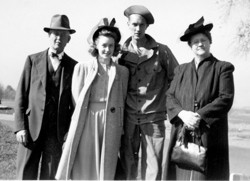 Induction Day with Mom, Dad and Sister Dagney
We finished basic training at the same time the new barracks were completed. We moved into our new quarters and we all got two stripes and assignments to permanent companies as cadre. The new recruits started arriving almost immediately. The T.O. of our unit called for a complement of 242 men. The majority of our company were from and induction center in western Pennsylvania and was comprised of steel mill workers and coal crackers from Pennsylvania, with a few West Virginians thrown in. When the training started, we were introduced to stuff like gas decontamination, gas protection, gas grenades and 4.2 inch mortars which could throw a shell filled with gas three quarters of a mile. In addition I was sent to school for training as the company clerk.
Until I got in the army I never knew what a lousy cook my mother was. She cooked in the Norwegian tradition, everything was white and unflavored. I didn't know you were supposed to taste food. The Army menu included potatoes I had never heard of, like American, home and French fried, It wasn't all mashed. And there was corn frittrers and stuffed peppers, hush puppies and the like, cold cuts other than baloney, condiments like ketchup, mustard and tobasco sauce sitting right there on the mess table. At Chrismas there were shared packages from home like pepperoni, peeroggis, pasta fazoola. I thought I was dying the first time I got heart burn.
At this time we were getting weekend passes and we would take the train or hitchhike after Saturday inspection to Atlanta, Birmingham or Chattanooga. I usually buddied up with one of the other corporals, One weekend, Frank Wright from Memphis, (not my roomie from Miami). and I decided to go up to Chattanooga and I was delayed in getting a report out and told Frank I would hitchhike up later and meet him in Chattanooga. I got a ride as far as Ft Payne without trouble, but could not catch a ride out of there going north, I tried for over an hour and it was starting to get dark so decided to hitch back to camp. A car that had passed me when I was looking for a ride north, stopped and the driver asked me where I was going and I went through the sad story of no rides, so his wife who was sitting next to him told me to get in and come home with them for supper. I didn't figure I had anything to loose so I piled in the back seat with their 13 year old shrew of a daughter who was riding back there . . . . . that is how I met the Durhams! Cecil and Esther and their two Children, James and Marjorie,
The next day I went to Sunday School with the Durhams at the First Baptist Church and after dinner we went up to Sand Mountain to an "All Day Sing" where gospel quartets from all over North Alabama came on stage and performed one after the other for the whole day, It was harmony with a beat. From then on I was hooked on southern gospel music.
Jim who worked at the US Royal Rubber plant in Gadsden gave me a lift back to camp Sunday evening. The Durhams became and still remain "family " to me and I to them. Marjorie is on her third husband now, James wife passed away some years ago and he remarried, to a grade school classmate. I talk to them regularly on the phone and visit them when I go to Florida.
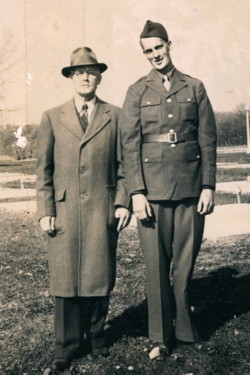 Home on Furlough with Dad
One evening during my furlough, after I came home from my date with Lil, my folks and I were chatting about the Army and how I was getting along and my dad said to my mom, "Well at least they taught him to polish the back of his shoes" . Then he turns to me and says tell me about duck hunting with Red Westby, and I asked him where he had heard about it, he said the story started in Strom's butcher shop after we had shipped out and within a week the whole neighborhood had heard it. Lloyd Berg, who lived next door to Westbys and was a butcher at Strom Meats was the fink, according to Hattie Ness, Arnie's younger brother. who laid the story on me in 1998 at the 50th wedding anniversary of my brother Erling.
After my furlough I returned to Camp Seibert and in April, along with a private named Merv Eyler, I went before the OCS board for written tests and interrogation, we had both applied for officer candidate school. Merv was from Gettysburg, PA and his wife had driven down when Merv was inducted and worked at the post PX. We were both accepted for OCS and we took turns hassling the board about when we would get into officer's training and all the answer we ever got was, "As soon as there is an opening".
On weekend passes I continued visiting the Durhams from time to time and also went to Birmingham a couple times as well as Chattanooga and Atlanta. Atlanta was not much in 1942, maybe 150, 000 population, so there was very little action there.
My other buddy from the cadre was Dick, (Fitzhugh Lee) Watson a good old country boy from Woodleaf NC. Cpl Watson was ten years older than I, and we went on weekend passes together too, he was always bucking for a leave, either his tobacco crop was rotting in the field or one of his mules was sick or had gone lame and couldn't pull the plow. But Dick was not as naive as the officers thought, he had a lot of street smarts, was married to the high school English teacher in his home town, who had followed him down for the summer and worked on the base. Dick was an avid reader and a good baseball player, we hit it off from the first day we were thrown together. We stayed in touch for several years after the war and I tried to contact him when we lived in Cary, NC, without success.
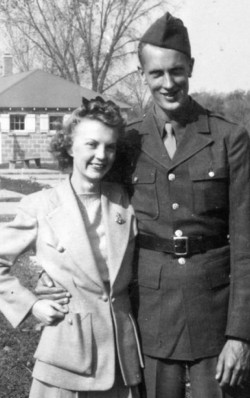 Herm and Lillian get Married
In September I got leave, I knew this was my overseas furlough so while I was home Lil and I decided to get married. Before that happened I was ordered back to Seibert by Western Union. Lil followed me down a couple days after I left and I met her in Ft Payne, we applied for our license at the Dekalb court house and we mere married in the Durham home by the pastor of the First Baptist Church. Cecil gave the bride away and Mrs Watson, Esther Durham , Dick Watson and Frank Wright were our witnesses. The date? September 28, 1943, a year from the day I was inducted. Lil followed me back to Gadsden and got a hotel room to await word to where we were shipping.
Europe
Through Dick Watson's wife we found out we were shipping to Camp Shanks, NY . Merv's wife said she was going to drive up and offered Lil a ride, which she accepted. The 122nd loaded onto a troop train on a spur in camp and we were out of there, through Knoxville, Washington, D.C. and the Jersey side of the Hudson River to Camp Shanks, which was near Nyack, NY, just across the river from Sing Sing Prison. Merv and I called all the hotels in Nyack, (a total of one) before we located our wives.
We were a week or so getting our final physicals, getting dental work done, setting up payroll deductions and trying on new uniforms. The only training we did was abandoning ship via the cargo nets. We had passes every night, the guys who lived in the NYC area went home every night, most of the fellows made the New York scene and wandered around Broadway looking for the Stage Door Canteen. Frank Wright and some of the lads went to a Manhattan night club where Charlie Barnett and his band were playing and Merv and I met our wives in Nyack every night for dinner and whatever.
One evening, without so much as a by your leave we were loaded onto a troop train, duffel bags and the whole bit for the one hour trip to Weehawkin, NJ where a ferry boat took us across the river to a pier where the Queen Elizabeth was tied up. We milled around on the docks waiting for our turn to board and had coffee and donuts served by the Red Cross . . . . . ten cents, please. . . . . That was the last dime the Red Cross ever got from me.
The Lizzy had been loading for three days, there were 10,000 troops aboard and we were the last to board. About 11 PM the tugs pulled the ship out into the Hudson River and we steamed past the Statue of Liberty and out to sea. We slept double bunked, one night in the swimming pool, which had been drained, and the next night out on the boat deck in a bed roll. The Q-1 was fast enough to travel without a convoy, so except for a dirigible that flew above us the first day, we traveled alone. The North Atlantic isn't exactly warm in late October and the deck was 90 feet above the water. Even if you could swim, if you had to abandon ship the fall would probably kill you.
We were four days crossing the Atlantic, If you were caught on deck not wearing a life preserver they took your shoes away from you until you came back wearing the jacket and redeemed your shoes. There were continuous poker and crap games around the clock, the ship supplied musical instruments and there was music in the stern lounge night and day, if a guy laid down his instrument and left, someone in the audience would move in pick it up and the band played on. There was no sheet music just an unending jam session played by some very good musicians. We had two meals a day, served in four shifts starting a t 8:00 AM. The last shift was through eating by 6:00 PM. We woke on the fifth day anchored in the Firth of Clyde along with 50 or more ships of every size and shape, Freighters, tankers, passenger ships, destroyers, cruisers, a couple of aircraft carriers, and a submarine.
When the disembarking commenced we were taken ashore by lighters and boarded trains waiting at dockside. Since we were the last outfit to board we were the last to leave the ship as well. So we had three days to wander the ship and watch the traffic in the harbor, Incidentally, the Clyde River comes down to the Firth from Glasgow and there was a lot of river traffic loading and unloading ships that were tied up, the wait was not at all boring.
A lighter finally put us ashore at Grenock where we boarded a train to Stranraer, Scotland. We crossed the Irish Sea by boat to Larne, Ireland. Back on a train to western Ulster to Omagh, the seat of County Tyrone. We marched through town to the fairgrounds were we set up camp in Quonset huts that had been occupied by troops of the Minnesota National Guard 34th Division before they shipped out to North Africa. We were advised we were now attached to the 8th Division , Regular Army.
County Tyrone is the ancestral home of Tyrone Power and of Errol Flynn. Errol Flynn's family still lived in Omagh in 1943 and his sister was a hostess at the Red Shield Club. The Red Shield was a sort of a half fast British USO Club. That was Omagh's claim to fame until 1999 when the IRA set off a car bomb in the street in front of what used to be O'Neil's Pub and killed 28 people.
We were out of Ireland in early spring and moved to a staging area at Stoke-On-Trent, England for more training and then to the Welsh border where we were quartered in a deer park between Shrewsbury and Welshpool. We spent a month unloading freight cars filled with ammo. Everything from hand grenades to 500 lb bombs, all containing various types of gas, this materiel was stored in a camouflaged area of the park. The atom bomb made all this stuff antiquated and since none of it was ever used I have often wondered what happened to it, and where they dumped it.
One weekend several of us on a thirty six hour pass went to a country fair in Shrewsbury, and in a game of chance, I do not intend to explain, I managed to brake my right hand. I tried to get first aid in town, but all they told me was to go back to my base. So I decided to tough it out and the four of us spent the leave time carousing as GIs are wont to do.
 Stationed in England, 1944
We were moved to Southampton shortly after D Day. We had spent over eight months in Europe and all of it in areas with little in the way of targets for the Luftwaffe, until Southampton we had not even heard an air raid siren, but then we got an overdose. Germany started using the V-1 missile in June of '44. The buzz bomb as we called it was a winged 2000 lb bomb and you could hear them go put-putting along overhead. The Brits shot at them with their anti aircraft batteries trying to explode them while they were still in the air. When you heard the air raid siren, you could duck into an air raid shelter or else get under the eaves of a building, if you didn't the shrapnel coming down from the ack ack could kill you if it hit you .
A buzz bomb itself presented a different problem. Almost at once after the engine quit it went into a dive and exploded on impact, so when you heard the put-putting stop there only time to drop to a prone position and pray that the bomb had passed by before the motor quit. Twice I stood and watched at night when the sirens indicated a V-1 bomb was on the way and it was a spectacular fireworks show what with spotlights and tracers combing the sky for the target.
D-Day Plus 30
On the evening of July 5, 1944, we boarded the "Star of India" which was tied up at the Southampton docks. This was a beat up old passenger ship converted to troop carrier for the cruising across the English Channel to France and back. Some time after dark we departed. When we came out on deck in the morning we were anchored off Utah Beach on D Day plus 30. There were blimps up and down the beach attached by steel cable to ships in the channel and along the shore to concrete embedded piers. The intention was to prevent any low level strafing of the beach and the channel by the Luftwaffe. We had been jammed down in the hold someplace overnight and slept in hammocks, If you had to go to the head you slipped out of the hammock and crawled on the deck under the rest of the hammocks to the john. Finding your hammock afterward was not easy.
We disembarked with full field pack and carbine down a cargo net to an LST which carried us within a hundred yards of the beach and then dumped us in three feet of water instead of taking us ashore, the skipper said he didn't want to get stranded on the beach at low tide and have to be pulled off. So we waded in got soaked from the waist down and then sloshed a mile or so to get off the beach to make room for what was left of the 82nd Airborne who were being relieved and were assembling to board the "Star" for the trip back to England. The 82nd paratroopers had jumped inland the night before D Day. Remember the Movie, "the Longest Day" and Red Buttons hanging from the church spire in St Mere Iglise? . . . . . These were the guys.
When I returned to St Mere Iglise fifty rears later at the anniversary commemoration, I was asked by a lady on our tour if I remembered it. I said, "It's impossible to remember what you glimpsed from the back of a six by six as you pass through town in the middle of the night".
When we waded ashore the cast which encased my arm from my fingers to my elbow got soaked and turned to mush, so I showed up at the medics tent the next day to get a new cast, at least to protect the back of my hand. The doctor on duty was a real quack, he said, "If you can't take any better care of your cast than that, I'm not gonna give you another one". Then he gave me an Ace Bandage. . . . . . Welcome to the 20th Corps!
The 20th Corps was comprised of several divisions and support units under Patton and had busted out of St Lo on the 1st of July and raced across Brittany, cut off the the German garrison in Brest and the submarine pens in St Nazaire.
Our outfit first was assigned to guard duty on a gasoline pipeline in the Rennes area after moving inland and one night Lt Tanis went out to check the guards and found a private from Geogia named Willie Showard drunk. Tanis took his gun away from him put him in the jeep, hauled him off to the stockade and charged him with being drunk on duty. While Willie was in jail some guardhouse lawyer got to him and when Willie came up for court martial Willie counter charged Tanis with desertion, claiming that when Tanis took his gun he assumed responsibility for the post which he then deserted when he took Willie to the stockade. Willie came back to the outfit, he said that all charges against him were dropped, but that Tanis had recieived a reprimand that was to go on his service record, which only made Tanis more of a schmuck than he already was.
 On Guard Duty in Nantes, France
The 8th division stayed in Brittany and became known as the brassiere division, are you ready for this? . . . . . . . .BECAUSE THEY CONTAINED BREST!!!!!
Meanwhile Patton took his armored divisions and went north out of St Lo to rendezvous with the British at Falaise, France, but General Montgomery never showed and the most of the Kraut Armies escaped out the Falaise gap and made it back to the fatherland to live and fight another day.
While the HQ of the company was stationed in Nantes, my squad dropped several unauthorized rounds from our 4.2s on the submarine pens. This somehow turned out to be a misuse of government property and I got busted again. In my heart I feel that the real reason for the demotion was because the krauts retaliated by answering with fire into Nantes with their 88s.
The 122nd was pulled out of the 83 Division, who remained in Brittany, and we moved east with the 92nd division, (another fresh off the boat division), through Le Mans meeting some opposition but taking a lot of prisoners. We had a lot of guys killed and wounded in these fire fights and by booby traps. A pump in a farm yard blew apart and killed tree guys when one of them tried to draw water for his canteen. I got some shrapnel in my legs and I was standing in the road at least 50 yards away. So I had the shrapnel removed by the medics and my legs bandaged and got the Purple Heart for loosing blood in battle..
On August 22 we were in the Paris freight yards waiting for the parade celebrating the recapture of Paris to end. Most US forces had bypassed Paris and kept moving east. We heard that the parade was mainly Free French Armored units under DeGaulle, some local Fifi underground forces, a British outfit and the American 28th Infantry which marched in formation down the Champs Elysees, under the Arc de Triomphe and out to waiting 6 by 6s to catch up with the rest of the US army and continue chasing the krauts. The 92nd Division continued by train to Chalon sur Marne which the Germans had abandoned. There the 122nd Company left the 92nd and moved up to Reims which had become some sort of staging area.
The army had outrun their supply lines and everything had ground to a halt until supplies could be brought up. Patton's 3rd Army had been raiding other units for gasoline in order to keep moving and they were stalled somewhere south, I think around Metz. We took over a chalet outside of Reims and just sort of settled in until we could get supplies and replacements which is what other units in the area were doing, The 13th and 17th Airborne units ( Two more divisions fresh off the boat) were quartered in the area as well as a couple of Infantry Divisions, with support units there were a lot of GIs in the area. The locals were very friendly and we seemed to get along okay with them.
As time passed and the buildup of men and material continued the USO came to town, took over the local opera house and presented a play, "The Barrett of Whimpole Street" staring Bryan O'Hearne and Elizabeth Browning of the Broadway stage. In two weeks the USO brought in "Arsenic and Old Lace" also with a Broadway cast, It was really impressive stuff. And it continued with new shows every couple weeks or so. And there were baseball games every afternoon between the various outfits that had teams.
After we got overseas Dick Watson had quit bucking for discharge and when our supply Sgt was injured Watson got the job, somebody among the officers must have realized what a gem this guy really was. He and I were sitting on our bunks the night after he had made his first run to Paris for cigarettes and the rest of our PX stuff and he said to me. "I was right there, saw the Arch of Triumph. Champs Elysees and Pont Neuf where Marie Antoinette was guillotined. I was actually walking where all this stuff that I had read about occurred". He was really impressed with Paris.
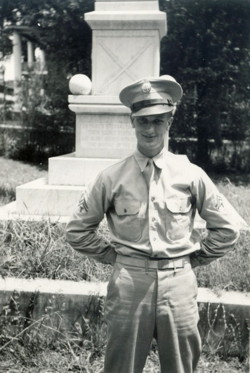 Stationed in France
The Quartermaster people finally located our stuff, mired in a field that had been flooded for defensive purposes. Getting the crates out of there proved to be a case of wallowing around in the muck and winching the crates out with our trucks. It was back breaking work that required a lot of shoveling to get the crates on solid ground so they could be skidded up onto a flat bed truck which the Red Ball Express trucked back to Reims for us the first week of December.
Battle of the Buldge
On Dec 16 the Germans attacked in the Ardennes and the Battle of the Bulge started. A couple days later we packed and moved out. Up until then I had thought of Reims and its cathedral as the place where the coronation of Joan of Arc took place, but as we left the chalet where we had been quartered it started snowing and our trucks entered town and drove down the main boulevard of Reims. Even today my strongest memory of Reims is the sight of the shop keepers out in the snow scraping the American flags off their store fronts. As we got out in the country more units joined the convoy moving up, and the snow became heavier and the roads icier up with all the heavy equipment on the move. The trip ended in Sedan a 70 mile trip which took us over five hours and we had to dig in after we got there. Sedan is northwest of Reims and on the Meuse River and our mission was to hold a bridge which had been erected by our Engineers after the Krauts dropped the concrete bridge into the river when they retreated. The town incidentally was the northern hinge of the Maginot Line and we were able to occupy some of the bunkers for protection from the elements. but we had no heat and no overshoes, so our feet were constantly wet, when we changed socks, we put the wet socks we took off under our arm pits to dry them and It didn't help. Christmas was a pretty somber occasion, I remember "Axis Sally" playing White Christmas for us from Berlin, I thought that was a bit much .
The German thrust, a total of 250.000 soldiers, accompanied by a 1.000 tanks. Their goal : first take Bastogne, head for the Meuse river and then push to the north of Belgium to take Antwerp and its strategic harbor. They were slowed down considerably by the fact that the 101st Airborne who had regrouped in England and returned to the mainland with replacements were quartered in Bastogne preparing for the push to the Rhine and across. Bastogne is about 60 miles east of Sedan.
The 101st held out until the middle of January when the third Army arrived with reinforcements and the weather cleared so that our planes could get up and give support to ground troops. Again the krauts were on the run, this time they had lost what was left of their Armored divisions and left thousands of guys dead in the snow as they retreated.
By February we were back in the chalet in Reims and I was sent to the hospital for treatment of trench foot, while I was in the hospital Captain Frevola gave me back my two stripes. I should have put them on with zippers. When I got back to the company, I get word that the company was being broken up and some 30 or more GIs had already shipped out as replacements for other outfits. My turn came a couple days after I got back and I was transferred to an embryo German POW outfit in Charleville, which was up north on the Meuse River about 20 miles from Sedan where we had been during the Bulge.
Army Buddies
A few recollections on the fellows, my closest friends with whom I soldiered in the 122nd;
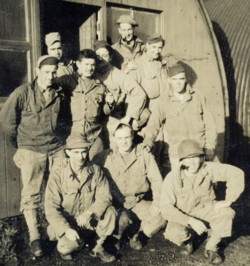 Army Buddies
Chick Bellici, . . . . . Brooklyn, NY Italian with a tenor voice so clear it could break glass. Killed crossing the Rhine on Easter Sunday, I went looking for his grave in Luxembourg during the fiftieth Anniversary tour. His family had had him disinterred and brought him home to a cemetery in Brooklyn.
Moose Henry, . . . . got busted with me in Brittany, he went back home to Tomah Wisconsin after the war, he and Bellici transferred to the same infantry outfit and he was with Chick when he was killed . Last time I saw Moose was when I was with Continental Insurance . He was on the police force and I rode with him one night in his prowl car and we reminisced as he made the rounds.
Bob Harvey, . . . . Bangor, ME, his family was French Canadian, he tutored me in French but my memory of him involves a French orphan kid about 10 who attached himself to our outfit back in Nantes. The kid just hung around the field kitchen for something to eat and the cooks befriended him, fed him, got him some GI clothing, hid him when the officers where around and found a place for him on the trucks as we moved up. If the the officers ever found out about him they obviously decided to ignore the kid. In time the kid spoke American, "as good as the cooks" . . . . .every other word was a four letter word, it so ticked Bob Harvey off that he grabbed the kid one day and told him he was gonna clean up the kid's mouth and teach him some English, instead of getting a lot of lip from the kid, the kid was so amazed that someone was interested in him for something other than his physical welfare that the he became a willing pupil, hung around Bob and took pride in his speech after a couple weeks . In '72 when we flew to Norway, we landed and gassed up in Bangor before the flight across the Atlantic and I tried to find Robert Harvey's name in the phone book, no luck.
There was of course Sgt Dick Watson and Lt. Merv Eyler who finally got into OCS overseas, Lil and I visited with them both in their homes after the war.
What was left of the 122nd, the nucleus, shipped stateside, their destination, . . . .The China, Burma, India Theater of War. They picked up replacements, had six weeks intense training back in Alabama and were given two weeks furlough prior to reporting for shipping overseas again. The war ended while they were on furlough. Dick Watson told me later , in lieu of the San Francisco Port of Embarkation, he was ordered to report to a separation center for discharge Except for what personal things he had taken on furlough he never saw any of his stuff or any of the guys from the 122nd again. . . . . .except me.
Guarding POWs
When I reported to Charleville I found that I was on the T of O list as the supply Sgt. and the cadre of this company, called a Labor Supervision Company, consisted of 5 NCOs and 2 officers, about the second day I had figured out that our officers were a couple of cast offs from other companys. Clarence E. McGee, originally from Philly was a 5'-3"character with LMS, a PFC in the regular army, who had gotten a battlefield commission for heroism during the bombing of Pearl Harbor. He was so dumb he couldn't find his butt with both hands and a mirror. The fact he was still a 2nd Lieutenant after almost 4 years in grade gave me the clue. 2nd Lt Boyson was from Tucson, stole a motorcycle from the the British a week before I got there and hid it in a barn up at our chalet, but got caught riding it drunk one night and he was gone before I even found out his first name.
When McGee finally got as organized as he ever was going to get, I began wondering what had happened to my promotion to supply Sgt. which was a staff rating. In talking between ourselves we NCOs had all been told that promotions automatically went with our transfer. About the first thing McGee said when we were finally assembled was that none of us enlist swine was getting his stripes until he got his Captaincy. This was not only pure chicken s--- , but I soon realized that a Captaincy was wishful thinking on his part. Finally, after about a month this POW camp, which was formerly a French pig farm got rolling, our truck drivers were the local French, the cooks under our chief cook were local housewives, as were the maids who cleaned and kept up the chalet that we lived in.
Our guards were 150 Yugoslavians all of whom claimed to have been officers in the Yugoslavian army. They could not be repatriated home because they were anti Titoists. Another 100 guards were Czechs, and lastly there were the Dutch, about 100 of them. None of us Gis were multi lingual in any language that would help us communicate with any of these people, much less the 2000 German POWs that were finally trucked in. Nor did any of us know anything about the job we were assigned to, luckily the Germans had competent people in the positions to which we had been assigned, we brought these people with expertise into the office to show us the ropes and we just more or less let them take over and run their own prison camp. Hans Becker was a very competent supply Sgt, he organized and ran the supply room for me, I did the paper work, ordered and secured the supplies. Together we did an adequate job, Our cook and I got along great. He gave me his order when I made a supply run, then we padded the lists for extras. McGee's signature was easy to forge and we soon had a little black market grift going to make up the difference in pay between a Cpl and a Staff rate to which we were entitled.
I drew the food and supplies as needed for the U.S. forces down in Reims and would go down there every two weeks for food staples, PX rations and items that were allotted to us occasionally like fresh fruit or vegetables. I went to Brussels, Belgium for booze and beer for the Charleville officer's club and as it turned out It proved profitable to kite the liquor requisition for a few more bottles of spirits for us enlisted swine.
It was about this time I opened a Soldier's Savings Account, you could deposit any amount you wanted into this account, no questions asked. The account paid around 5% interest, but you could not draw on it until you were discharged. Since you couldn't mail home more than the amount of your monthly pay, it was a convenient depository for poker winnings and other windfalls that would come a soldier's way from time to time.
My weekly supply run was to Luxemburgh for the foodstuffs for the POWs and I had two 16 year old German POWs who spoke English who would ride with me and do the loading and the lifting on these trips. They had been drafted in the last days of the war in Europe and were sent to the front without training or even a gun and were told to get their guns off dead soldiers when they got up to the lines. This one kid said, "The first American soldier I saw I threw up my hands and started screaming camerade!"
On all my trips I carried a 45 automatic in a shoulder holster when the kids were with me, I don't know why, I used to leave the kids with the truck to watch it when I went into the supply offices or to stop and have a beer on the road, but this was McGee's orders. On one of these trips I stopped for a beer and when I came out the truck was full of local kids and these two guys were feeding them candy and gum from the PX rations and getting along as kids are wont to do. When I asked them whatnhell was going on, the one kid said that he was from nearby Saar Basin and was maybe 20 miles from home, I asked him why he hadn't gone over the hill. He said he came from a big family, his dad was gone, they had very little to eat at home and he had never had it so good as it was for him in the POW camp. So we drove down to the kid's home town so he could visit with his mother and his siblings and I lost a couple cases of C rations as we left.
The POWs were farmed out to the locals to work on farms, forest or in industry. A US Army Replacement Depot furnished G.I.s and transportation when a crew went out to work. The rest of the POWs who were not assigned to some specific duty in camp went up to the arsenal to work at defusing ammunition,
Train load after train load of ammunition was brought into an arsenal which was established out in the country away from population. The ammo was unloaded and the primers removed by our POWs then the ammo was loaded back onto trains and hauled up to Antwerp, Belgium where it was loaded onto freighters and hauled out to sea and dumped. Disarmament was the basic function of our camp. It was hazardous work and hardly a day went by without an explosion or a fire. The POWs loved it when they brought in buzz bombs, buzz bomb fluid was about 98 % pure alcohol and when it was drained from the fuel tanks the prisoners got a chance to get a buzz on too, this also rankled McGee.
Around the clock guard duty was handled by the Nationals who set up their own shifts and pulled a week at a time before being relieved. We NCOs pulled night duty every fifth night and slept in the office in a bedroom we had set up. Our duty was mainly having an American present.
One night I was pulling duty and the guards for that week were the Dutch and between his rounds I got to chatting with their Sgt of the Guard who spoke English and asked him why he didn't go home. He said he was waiting to be repatriated and I asked him who was going to do that, he didn't know. As we talked, I asked him why he didn't repatriate himself. I told him he was wearing an American uniform, the train for Brussels stopped in Mezieres every night, the US Army had taken over the railroads and everything was in such a state of flux that nobody was checking papers or IDs and people where just getting on an off the trains. The time I took the train to Reims on pass I didn't even see anyone pay. I was sure he could catch a train to Holland after he got to Brussels because the Brits were running the show up there and they were more screwed up than we were..
The next day he was gone, but returned in a week, he didn't talk to me, but a couple days later most of the Dutch contingent slipped out and was gone. One of the guys who had stayed in camp got a post card some time later telling that they had all made it home. He told me his family had been killed and he and the rest stayed because they hoped it would be their ticket stateside. McGee was livid, they hadn't replaced Boyson and he was sore about that and now he had lost the only guards he could depend on.
I had the satisfaction of knowing I had given the shaft to McGee one more time.
Some time after the departure of the Dutch, one of the prisoners was killed by a Czechoslovakian guard, shot in cold blood in the compound, turned out the German he killed had been a hard nosed guard at the plant where the Czech had been a slave worker.
The latrines for the POWs were slit trenches about twenty feet long with logs to sit on for the guys to do their business, a roof was all they had for protection from the elements and the place was open on all four sides. There were spot lights on at night and a twenty four hour posted guard watched every movement inside, (pun intended). One morning at the height of the (business hour) one of the guards went berserk, opened up with a 30 Cal sub machine gun, made a couple passes across the sitting ducks wounding about ten and killing two prisoners outright. The guys who weren't hit saved themselves by falling into the trench.
A death in the camp called for an investigation, especially by the International Red Cross who made a big stink about anything untoward. Before you could remove the body from the scene you had to get a death certificate which for some reason needed a statement from the Red Cross. The latrine fiasco resulted in an all day hearing. At dusk I got the task of hauling the two bodies to the cemetery in Trier. The trip took about three hours at night with a hundred miles of those bodies rolling around in the back of the truck bouncing off the sides as I went around curves, an eerie feeling I didn't get over for awhile.
Early on in our organization of the PW camp we had all the prisoners fall out and take off their shirts, we then went down the lines looking for numbers tattooed on the left shoulder of each German. We found around 20 POWs with said numbers. These guys were SS troops, Hitler's elite storm troopers. We believed some of them were also Gestapo bullies. We had constructed a 20 by 20 enclosure of barb wire 12 feet high, lighted day and night with 500 watt spotlights. No beds, no facilities just a slit trench and a blanket. These guys were held in the "Bull Pen" until their records were checked out, or they were identified, Then they were picked up and carted off by a special military police force for trial, incarceration or whatever. Some of these guys stayed in the bull pen up to a month without ever getting out, having their food on a tray shoved under the barb wire and never being able to avoid those lights. From time to time the army would bring us stragglers who were caught hiding some place and about half of them were storm troopers so we always had some one in the bull pen,
Some time after the hostilities in the Pacific ceased, I went over to our office one afternoon when I was scheduled for all night duty and was sitting at the desk reading, I was leaning back in the chair, my feet up on the desk when an air force officer wearing pinks and a 50 mission cap came into the office. I greeted him with, "What's on your mind Lieutenant?" And did I get a chewing out from him, "That the way you address an officer? Get your feet off that desk and stand at attention!" I was starting to get steamed because I was under the impression the war was over and here is this Sky Jockey , of all people, getting GI with me . I thought, if it was POWs he was after to sign out as waiters, bus boys and bar tenders for some rinky dink gala the Air Force had going on, he was going to have to use Air Force personnel, he sure as hell wasn't getting any POWs from our compound..
Turns out it was Lil's brother Don whom I had never met. I don't recall where he was stationed, but he was pulling temporary duty in Paris for a few days and had checked out a jeep and driven up to meet me. A lousy way to meet your in-laws, but I suppose it was better than being invited to your fiance's home for Sunday dinner and meet his brothers Bob and Harold and him all at the same time.
We chatted away most of the night before he left to go back to Paris. The one story he left me with was that he was in Paris when the war ended and he recounted that some American fighter pilots had buzzed Paris on VJ day, flew down the Champs Elysees in formation at tree top level with the intention of flying thru the Arch of Triumph and at the last minute had to pull up in a steep climb to avoid getting tangled up in the flags hanging across the arch. Very spectacular,. "Tres magnifique" according to the Parisians who thought it was all planned.
On Leave
In October , with another GI whose name I no longer recall, I got two weeks RR&R. (rest. recuperation and rehabilitation) by reason of having enough points for discharge, but frozen in grade. We took off by train from Mezieres for the French Riviera, Nice to be exact. with a change of trains in Paris.
The trip from Paris to Marseilles and on to Nice was on a typical European passenger train of the time, with an interior aisle down the left side of the coach and doors in each compartment to the station platforms on the right side. Passengers entered and left the the train through these doors. The seats were wicker, uncomfortable and faced each other in each compartment. We spent two nights on this train with passengers boarding and leaving the train into or off our compartment at almost every stop. Very little sleep, and the food? You got off the train ran into the station to buy something at a counter while the train was disgorging passengers and then rush to get back on before the train pulled out of the station. After 36 hours on this rattler you needed RR&R just to get over the trip.
Once we got to Nice we were treated royally, private rooms with bath in the Nigrasco Hotel on the Mediterranean waterfront, uniforms were optional, so most GIs ran around in T shirts, khakis and sandals. There were charter buses into the foothills, which included a trip to Mentone Italy and the return trip with a stop at a restaurant in the hills above Monte Carlo, which was off limits to all Army personnel. But you could see the harbor and the Casino down below.
My Sgt. buddy and I had hitched out to Cannes one day during our stay and during this adventure discovered an air strip half way between Nice and Cannes with USA C37 cargo planes parked on the hard pan. A few enquiries determined that the planes parked there flew to and from many European cities every day, including Paris. So . . . . . . between us we decided, two days before we were scheduled to leave, to go out to the air strip and hang around. We found the crew of a plane scheduled for Paris, played a little, "who do you know?" with them, were invited aboard bthe plane, found a couple of bucket seats clicked on the seat belts and we were in Orly Airport before noon. It was a great trip compared to the trip on the train which we had been dreading. We caught a truck into Paris and were wandering around trying to figure how we were going to spend the time until we were due back at our outfits. We were sitting in a sidewalk cafe sipping our lunch when I spotted Bernie Pollard directing traffic. (You remember old Bernie from Page 15 don't you?).
When Bernie came off duty he came over and joined us, took us under his wing, got chits for us to stay at the GI hotel on Houseman Blvd and meal tickets at a GI mess hall for a week and we were in business doing the Paris scene, including the Palace at Versailles, Notre Dame Cathedral, Champs Elysees, the Eiffel Tower, Pont Neuf, Place Pigalle the Glen Miller Band et al. Paris was easy to get around on the Metro. I would see Bernie from time to time when he came off duty and would have a drink with him and reminisce and catch up our comings and goings since we helped bust up that pub back in Omagh, so I had a great time for the week I was "lost " in Paris.
I got back to Charleville and found I had been listed two days AWOL, but I explained that it was easy for a lad from a small Midwestern city to get lost in a big city like Paris, I didn't much care if the excuse worked or not as I was feeling kind of draggy assed anyway, so what is McGee going to do about it. He had already given me the shaft and he needed me..
Tuberculosis
Any way the dopey feeling seemed to hang on, I couldn't shake it and after a couple weeks I went on sick call. The medic sent me down to the hospital in Reims for observation and tests, where they determined I had T.B.
So I had my ticket back to the states, and I never got to say good bye to Clarence E. McGee. My barracks bag was brought down to the hospital and a few days later I was loaded on a hospital train bound for the port of Cherbourg. As we passed through Normandy I looked out the window of the train and recalled the skeleton of the cow I saw in the top of a tree when we first came ashore over a year before I couldnt help but wonder if it was still there.
The hospital ship LARKSPUR, was a former German lighter taken as reparations by the US after WW! and converted for use In WWII as a floating hospital, she was at the pier when the train arrived in Cherbourg and loading. The train went out on the pier along side the ship and the patients were brought up the gang plank. I was assigned a bed in a four bed isolation room. None of us were very sick but we were not allowed to "mingle". First food I had aboard ship was a white bread and butter sandwich and a glass of fresh whole milk, the first in over two years and it tasted like malted milk and cake!
Halloween night, we cast off out of Cherbourg and 11 days later, after an uneventful crossing, we steamed up the Hudson River past the warehouses on the river front in Brooklyn that had lettering twelve feet high reading , "WELCOME HOME, WELL DONE". It was Armistice Day and fire boats came out from shore and kept circling our ship with sirens blaring and shooting water spouts a hundred feet in the air . A ferry boat picked us up at the Statue of Liberty and cruised along side us with a band playing. It was Sunday afternoon, we passed the Battery and proceeded up the Hudson River, cars along the West Side Highway stopped, parked and honked their horns. At around Pier 50 there were ambulances lined up waiting for us, we docked and started unloading at once
The New York State Children's Hospital had been converted to a receiving hospital for returning sick and wounded GIs and it was nightfall before I was taken off the ship to an ambulance and carted through the Holland Tunnel and down to Staten Island via Bayonne, NJ. It had been a most impressive welcome home.
Every ward in the hospital had a battery of phones, so that night I was able to call Lil first and talk to her and then call my folks. My mother had written me when I was in France that my dad was ill, but as I talked to her now, she confirmed that my dad had terminal lung cancer. The Red Cross had been contacted and that my brother Erling was expected home on emergency leave from Japan where he was in the army of occupation. My dad was home from the hospital as there was nothing more that they could do for him, so I was able to talk to him at some length after my mother turned the phone over to him, he seemed more worried about my condition than his.
I was at the Staten Island Hospital for about a week, I talked to Lil and my folks every day. My mother told me to call Pastor Walstad, (the pastor who had confirmed me) as he was back at Trinity Lutheran Church in Brooklyn. He was on reserve duty as an Army Chaplain and doing double duty at Trinity as their associate pastor. So I called him one day and all he said was, "Where are you? . . . . . I'll be over".
The same day he and his wife Ruth came over. Major Walstad shows up wearing his dress pinks with the Third Armored Division, "Hell on Wheels" patch on his shoulder and a chest full of ribbons. The Third was Patton's spearhead division. It was a smashing entrance, I must say. He was still awaiting discharge, but as a reserve, still at the army's beck and call. We chatted a bit about families and the like and he and I refought the war some, and found we had been in the same zones a couple times. He gave a bit of a homily for the guys on the ward, prayed for us all and left. I saw him a couple years later when Lil and I were in Brooklyn visiting her kin and the last time in 1968 outside Fairview Hospital in Mpls, where we were both visiting patients.
Off to New Mexico
After a week or so of sorting out patients, their ailments, wounds, whatever, and determining their destinations I was once more on a hospital train. Destination; cross country to Bruns General Hospital, Santa Fe, New Mexico. The trip took several days as they dropped off coaches along the way at other Army installations. Our coach containing 40 stacked bunks was comprised solely of tubercular patients attended by three nurses and a medic round the clock. We were several days en route and we finally pulled onto a spur somewhere in the the New Mexico Rockies. if memory serves me correctly the name of the town was Glorieta . It seems that even though Santa Fe has a railroad named for the city there are no rails into town. So we were brought up the rest of the mountain, some ten miles to the Army Hospital (which was just across the road from the State Penitentiary) by ambulance.
The hospital layout was typically army temporary; one story buildings each building contained the nurses charge office, several private rooms plus a big ward with maybe 20 beds and a sun porch which served as a day room, for card playing, a place to visit with company etc. Each building was connected by a ramp at the office end of the ward.
In my ward were returnees from every theater of war from around the world, including two survivors of the Bataan Death March, and a "Hopi Indian Talker", who had been stationed in the South Pacific. The Hopis were used on portable radio communications between Army units because the Hopi language could not be translated to any other known language and the Hopi Talkers were used extensively in the Pacific. I never heard his real name because everybody called him "Chief"
For the most part none of us were very sick, we were on "bed rest" and had the run of the ward, patients requiring other treatment; oxygen and the like had the private rooms. There were no restrictions on smoking, so there was not much of a hospital atmosphere in any sense of the word. The only medication I got was an ounce of whiskey before meals to increase my appetite. (I have adhered to this treatment before dinner each night ever since, nearly 55 years now)
The USO sent groups though at least once a month, the only notable person I remember coming through was Jane Russell, who sang for us. She didn't have all that a great a voice, but she did have a couple of things going for her . . . . . We had the latest movies a couple times a week, the projector and screen was set up in the ward and we watched the movies from the sack and our visitors were provided chairs . For several days after pay day there were poker and black jack games on the porch until all the money on the ward ended up in the possession of one or two guys. And there was a library cart that came through the ward every other day or so.
There was a continuous bull session, we all told great war stories. Relating incidents that had happened to us, or in our outfit, or in our Theater of Operations, or that we had heard someplace or from some one. And they went on and on. Years later I was given the Brokaw book, "The Greatest Generation", and after reading about thirty pages or so, I knew I had heard it all before. The book has the same war stories from bull sessions I heard at Bruns General. These stories have become "Urban Legends" and Brokow had put names to all these incidents.
We were not allowed passes as we were supposed to be contagious, but there was no fence around the hospital and our uniforms were in footlockers at the foot of each bed, so going over the "wall" and into Santa Fe was no problem since the bus to town stopped a block or so from our ward.
If this sounds like the high living, it was! I don't think there was any thought given to effecting a cure for us, this was basically a holding tank until the Army could discharge us and dump us into the care of the Veteran's Administration.
There were guest facilities provided for out of town visitors and family and we were encouraged to have visitors. So shortly after I was settled in Lil took a leave of absence from her job and flew down to Santa Fe to visit me.
About a week after her arrival we got a phone call that her dad, Ole Faro, who was a high voltage lineman for Northern States Power had been seriously injured when he came in contact with 10, 000 volts of a primary line electricity on the job and she left for home immediately to be with her mother. Ole ultimately recovered, but lost an arm and suffered a lot of nerve damage as a result of the accident.
On January 11, 1946 my dad died at the age of 73, at home in his own bed and I got a compassionate leave and an escort to go home by train. I attended the funeral services at the Minnehaha Lutheran Church and was home for a couple weeks before retuning to Santa Fe.
During the time I was at home I made enquiries regarding a transfer to the Vets Hospital at Ft Snelling, which Lil pursued after my return to Santa Fe. She was told the VA hospital was full and not accepting tuberculars. Somehow she picked up a rumor that Glen Lake Sanatorium was accepting Veterans and through dogged persistence on her part was able to put a "hold" on a bed there in the spring of '46.
Some time in February my mother came down to visit me, my siblings felt she needed to get away after the strain of caring for my dad and she did enjoy visiting me every day, kidding with the other guys on the ward and chatting with them about their families and war experiences. The movie we saw the week she visited me was a Red Skelton comedy, (she didn't know him from Jim Nelson, whatever), but he did his famous "Guzzler's Gin" sales pitch routine in the movie and I thought she would come unglued. She loved all that slap stick stuff. This was a different lady from the one that used to beat me up regularly. What she did to me then would be considered child abuse today and she would be in jail just for chastising me.
Working on a Transfer
Working through social services at Bruns I was getting nowhere in effecting a discharge and transfer to Glen Lake and to add to the problem there were rumors that the hospital was being closed and we were all being transferred to other Army Hospitals.
In April it became official, the hospital was indeed closing and in May the shipping list came out and I was on a list to go to the Swananoa Army General Hospital in Asheville, North Carolina. Another army screw up, but I took a page from a Texan on my ward and sent a night letter via Western Union to Senator Humphry's Office in Washington, citing the fact that I had a bed reserved for me at Glen Lake, but instead of being transferred there, I was now on a shipping list to transfer to a hospital in North Carolina. I also said that a patient on my ward from Texas with a bed waiting for him in San Antonio had contacted his senator and was taken off the shipping list and his discharge and transfer to San Antonio was presently being processed. I wound up the letter by writing, "Mr Senator, If Pappy O'Daniel can do it for his constituent, I know you can do it for me".
The next morning the nurse said there was a call for me in her office and I went in to take a call from Senator Humphry's aide who wanted all the particulars relative to my telegram. The next day I was off the shipping list, and June 6 1946 I received my discharge, my soldiers savings account and a duffel bag with my junk and I was on my way to Glen Lake. Come hell or high waterI have voted a straight Democratic ticket ever since. Always go home with the guy who brought you to the dance.
New Mexico Stories
Before I go on I must recount a couple of incidents related to my stay in New Mexico;
Three of us went over the hill and spent a weekend in Albuquerque, just to get away from the army and the chicken S---. I remember going out to see Ernie Pyle's home, (In case you don't know about him , He was the war correspondent who wrote a column for The Hearst Syndicate Newspapers, I believe, entitled "THIS IS YOUR WAR" and it consisted of interviews with front line soldiers with their names, their home towns and messages to the folks back home. Real folksy stuff from The North African and Italian campaigns. From there he left to write about the war in the Pacific and was killed during an invasion of a small island in the Pacific and is buried in the Punch Bowl Cemetery in Hawaii. The movie "The story of G.I. Joe" starring Robert Mitchum was based on Ernie Pyle and his coverage of the war in Italy.
Another incident I recall occurred in Santa Fe when four of us decided to go into town after chow one evening and since we all couldn't go out the back porch door at once we agreed to meet in the bar of the La Fonda hotel in Santa Fe. I was the first one into town, so I got a booth at the La Fonda bar and ordered a drink which I was nursing when a Bird Colonel with a drink in hand came over and asked if he could join me, since I was outranked, I invited him to to sit down and we chatted about the war and where we had been, he asked about the "Bulge" about cold weather gear, the army rations and how we were generally treated and he wanted to know why I had four hash marks on my sleeve and no other decorations. It was the usual bull session when a couple of soldiers get together and play "who do you know" strange as it seems, even tho' he was an officer, our conversation was real buddy buddy stuff. I told him of my train ride back to Mezieres from R R and R and of the Red Cross lady who got into our compartment who was wearing all five battle stars on her ETO ribbon which teed me off no end since I only had four stars and it rankled me enough that I decided I would never wear my awards again.
About that time the MPs making the rounds came over and said no fraternization between officers and enlisted swine and were about to hustle me out. I started to get up and the Colonel said no it's his booth and he got up, departed and said he had enjoyed the visit. After he was gone the rest of the guys from my ward who had been waiting at the bar came over and joined me.
The next morning one of the guys asked me if I knew who it was I was drinking with last night at the LaFonda and I said I didn't know. He said, "The guy's picture is on the front page of the paper this morning". It was indeed the gentleman I had been conversing with and the man's name was Quentin Rockefeller. The story accompanying his picture indicated he was on a special assignment for President Truman interviewing GIs about their gripes about the army. Mr Rockefeller later became the democrat Governor of Arkansas. (See, Arkansas did have a Governor before Clinton). As I said before, " Always go home with the guy who brought you to the dance".
On several occasions during my time at Bruns we had severe power failures, the lights didn't just shut off, they dimmed down slowly until they went down to a glimmer and remained down for a few minutes and then came on quite rapidly. I don't know if it was true but the rumor was that the lights went down when they executed a prisoner at the State Pen across the road.
I also learned to knit from the physical therapist at Burns and made stuff like scarfs, sweaters and Afghans. Knitting is like riding a bicycle, once you learn you never forget it. Strange as it seems, I would have to lie down to do it . . . . . knit , I mean.
I found things a lot different at Glen Lake than at Bruns, three patients to a room and strict bed rest and that was 24 hours a day, including meals, bed pans, baths, whatever, and you were never allowed to put a foot on the floor. If you went anywhere it was on a gurney, no chance for any "over the hill stuff", especially from the the third floor where my room was. Treatment consisted mostly of bed rest, but in my case they kept my right lung collapsed with a therapy called pneumo thorax. When tests indicated your active TB was "arrested", you were allowed to spend a part of your day walking on your floor only, or "working up" to get your strength back and recover some muscle tone, plus you went to the dining room for meals.
During the last stages of working up for discharge you were transferred to "the cottage", a two story building set off from the main hospital to complete your work up, there things were much more lenient. You got weekend passes to spend at home with your family and you got into physical and occupational therapy and were able to socialize with other patients who were also working up. Except for nap time every day from one to three PM and a 9:00 o'clock bed check every night you were pretty much on your own. Pauly's bar in Chanhassen was a congregating place, especially for the eight or ten ex GIs, who were working up at the same time I was and who had money, access to cars and tended isolate themselves from the other patients and hang out together. Windows on the first floor of the cottages became an egress many nights after bed check.
Delayed Honeymoon
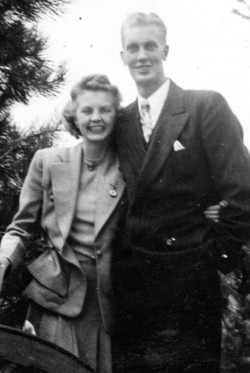 On their honeymoon
We left Alabama for North Carolina with stops in Atlanta and Columbia on the way In Charlotte we spent a couple days with Bud and Gloria Bordsen. Bud you will remember, was from our old neighborhood and had met and married Gloria while he was stationed in Charlotte, he brought her back to Mpls after the war to finish school and get his degree from the U of M. Bordsens and their daughter moved back to Charlotte and Bud joined his father-in-law's accounting firm . In Woodleaf we visited Dick and Linda Watson, Dick was back at farming, still raising tobbaco and cotton and having trouble with his mules. We continued north through Virginia to Washington to my cousin Ray Fadner, who gave us the six bit tour of Washington tourist traps during our weekend at his place.
Our next stop was Baltimore where we free loaded off the Eylers, Merv was in the seminary at the time studying for the ministry on the GI bill, after a couple days with them we traveled up the coast through Jersey and on over to Brooklyn to Lil's cousin Arne's place where we spent about a week before starting home with a young Norwegian exchange student from Lafayette College, name of Lasse Dyrdal who was kin of Arne's . He rode back to Minneapolis, spent a couple days there before he continued his hitch hiking across the US before returning to school and ultimately to Norway. In 1972 when I was in Norway I looked him up and found that he was the top dog at "Radio Norway", but I was unable to contact him.
So now you have the story of our honeymoon . . . . except for one thing. Lil got pregnant while we were in the Southland . . . .and if you wondered why, Mike . . . . your middle name is Lee ? . . . . . . . like in Robert E ?